We thought we knew what to expect. We were wrong.
Two years into Good Life 2030 Ireland, the Impact Report is out. Here's what surprised us most.
When we set out to bring together Ireland's advertising industry around a climate brief, we had a theory of what would happen. Creatives would engage. A campaign would be made. Some people would see it and feel something. We'd measure the shift and report back.
What we didn't plan for was what would happen in the room.
Good Life 2030 Ireland was a two-year project funded by the Irish Government through Creative Ireland, built on a simple but ambitious premise: what if the advertising industry used its power to make sustainable living feel genuinely desirable, rather than dutiful? Working with THINKHOUSE and 40 creatives from 10 leading agencies, we set out to find out. The full Impact Report is now available, and it tells the story in full. But here are the moments that stopped us in our tracks.
People already know what they want. They just haven't been asked.
Before a single brief was written, we spent months in conversation with citizens across Ireland. Not asking them about sustainability. Not asking about climate. Asking them what a good life looks like in 2030.
What came back was consistent and quietly radical. People wanted to slow down. To know their neighbours. To spend more time outside. To feel like they had enough. These weren't niche answers from committed environmentalists. They came from people of all ages and backgrounds, across the country.
77% of Irish adults agreed that the advertising industry should help people lead healthy, sustainable lives. 43% of research participants said they had already made, or planned to make, real changes to how they lived after taking part, from joining Tidy Towns to rethinking where they raised their families.
The appetite was there all along. The industry just hadn't made space for it.
The surprise wasn't the campaign. It was the people making it.
When 40 creatives from 10 competing agencies walked into a room together, we expected some friction. What we got was something closer to relief.
Participants were surprised by how quickly the competitive instinct dissolved when the brief pointed somewhere meaningful. They were surprised by how much they'd been carrying quietly, assuming they were the only one in their agency who felt the industry needed to change direction. And many were surprised that climate storytelling could feel this alive, this good to work on, rather than heavy or hair-shirt.
One creative reflected: "What surprised me most was the depth of its message and the emotional resonance it carried. It wasn't just another campaign. It challenged societal norms and encouraged people to rethink their relationship with consumerism. That, for me, was incredibly refreshing and rewarding to be a part of."
Another spoke about "becoming vulnerable with others from across the industry, realising that many of us are having similar thoughts and dreams."
That's not a metric. That's community.
The number we keep coming back to.
After the workshops, we asked participants to respond to a series of statements. One read: "I want to spend more of my time collaborating with others in the industry to promote pro-environmental values."
100% agreed.
Not a majority. Not most. Everyone.
In an industry built on competing for attention, talent and revenue, unanimity on anything is rare. On this, it was total. What that tells us is that the infrastructure for industry-wide climate action already exists inside people. It just needs somewhere to go.
The campaign held its ground.
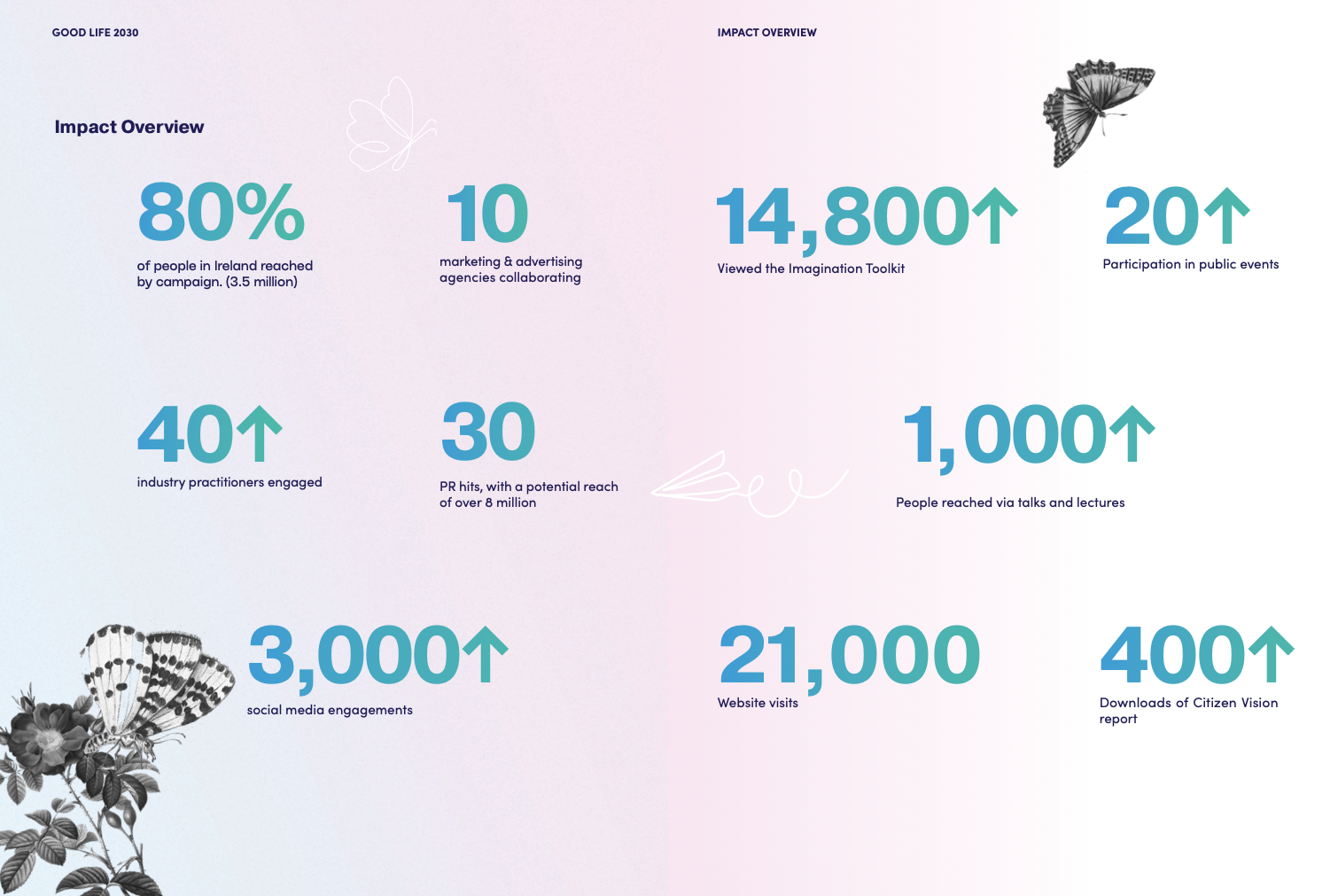
Less Buying, More Being launched on Black Friday 2024 into the loudest commercial moment of the year. Media partners donated over €450,000 in space. The campaign reached an estimated 3.5 million people. Post-campaign research found that 58% of those who saw it felt more confident they didn't need to buy things to feel happy. Over half said it inspired them to see sustainable behaviour as something desirable rather than difficult.
A woman wrote in to say it made her "breathe out between a stressful and never stopping ad-filled world." A 20-year-old said it made him think, for the first time, about how much advertising shapes both culture and emissions.
These aren't data points. They're people responding to being seen.
We won't gloss over the friction.
When a Good Life 2030 print ad appeared in the Irish Times directly opposite a fossil fuel SUV ad, it was a sharp and uncomfortable reminder of the structural reality this work operates within. Some media partners were hesitant to run lines that directly challenged consumption culture. The campaign had to hold its ground inside a system it was also trying to change.
That tension isn't a failure of the project. It's the whole point of it.
What we're doing next.
This report is not a conclusion. It's an evidence base. Good Life 2030 will continue as a core pillar of Purpose Disruptors' work. We want to expand the citizen vision research, develop the next generation of Irish creatives through a new Good Life brief, and launch an Irish chapter of Agency for Nature.
We believe the advertising industry holds disproportionate power over culture, aspiration and behaviour. We also believe, more than ever, that the people inside it are ready to use that power differently.
The full Impact Report is available to download now. It contains the data, the honest reckoning with what worked and what didn't, and the case for what needs to happen next.
With thanks to our partners
Good Life 2030 Ireland is a recipient of the Creative Climate Action fund, an initiative from the Creative Ireland Programme.