Nature as subject or nature as author?
What the Talking Tree is teaching us about giving nature a voice
On Sunday 26th April, The Talking Tree – an Agency for Nature campaign developed with Droga5 – was announced as one of Columbia University’s “Digital Dozen: Breakthroughs in Storytelling.” The award honours projects that stretch what narrative can be in the digital age. For us, it’s also a chance to reflect on a more provocative question: is the Talking Tree just a clever story about nature – or the beginning of stories by nature?

Why a talking tree?
The brief Agency for Nature’s Droga5 team tackled was simple: what if we used the newest intelligence – AI – in service of the oldest intelligence – trees?
Britain is the most nature-disconnected country in Europe, with young people the most disconnected group of all. They spend hours each day on their phones and, increasingly, turn to AI chatbots for the very things nature used to give us: companionship, reflection and solace.
Instead of fighting that, the Talking Tree tries to redirect it. If young people are already in deep, daily conversation with digital systems, what happens if one of those systems acts as a bridge back to the living world?
How it works: a tree with a brain
Technically, the Talking Tree is a hybrid of ecology, sensors and AI. The team attached around ten sensors to living trees – measuring bioelectrical signals, soil moisture, pH, air temperature, humidity, sunlight, wind speed and air quality. This live data is fed into a locally hosted large language model that functions as the “brain” of the tree, combining sensory signals with knowledge about species history and local context to generate a unique tree “personality”.
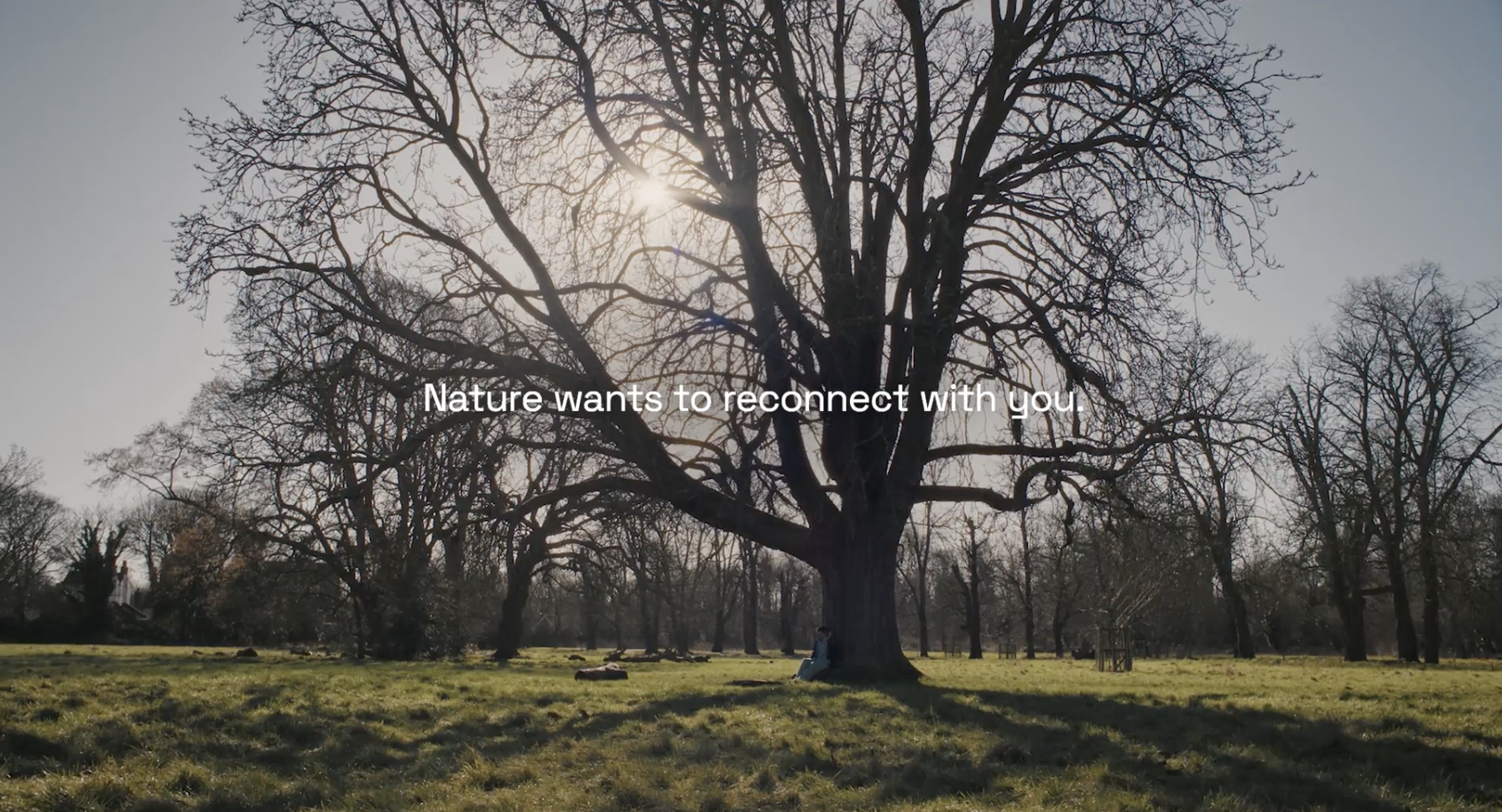
Visitors can then have real-time spoken conversations with the tree. Over 2025, three trees took part: a 150‑year‑old horse chestnut in Morden Hall Park in London, a live oak at SXSW in Austin, and a 200‑year‑old London plane at Trinity College, Dublin. Each tree responded differently, because each tree’s data, history and place are different.
From a storytelling perspective, that’s the first shift: this isn’t a fixed script about a tree, but a living dialogue with infinite possibilities.
What people actually talked about
Over its first outings, people spent more than 80 hours talking with the trees. Some came back multiple times. A student in Dublin said, “I wasn’t expecting to be able to do this ever. I won’t look at trees the same way again.”
We expected curiosity – “What does the soil feel like?” – and a bit of tech‑novelty. What surprised us was how quickly the conversations went somewhere deeper.
Again and again, people asked the same kind of questions:
“What do you think of humans?”
“What can we learn from you?”
“Will you survive climate change?”
Nobody prompted them to talk about the climate crisis, or responsibility. The tree’s perspective – grounded in decades of weather data and growth – made those themes feel obvious, almost inevitable. The tree became a kind of elder.
Nature as subject vs nature as author
So is this nature speaking?
On one level, of course, the tree’s “voice” is mediated and constrained. A human-built model is interpreting tree signals and plugging them into human language. The ethical risks are real: anthropomorphism, sentimentality, and the illusion that tech has magically solved our separation.
But three meaningful shifts do feel important:
The tree is the narrator, not the backdrop.
Instead of being the scenery for human drama, the tree sits at the centre of the frame. It initiates responses. It has a point of view.The story is different every time.
Because the narrative is driven by live data and live dialogue, the tree’s “mood” and reflections change with the weather, the soil, the time of day and the questions asked. The story is generated by an ongoing relationship, not a one‑off message.Empathy, not information, is the mechanism.
The experience doesn’t tell people about biodiversity loss or quote statistics. It invites them into a relationship – one that is slightly unsettling, a little awe‑inducing, and hard to shake.
This is where the distinction between nature as subject and nature as author starts to blur.
Awe as a doorway for new relations with nature
At Agency for Nature, we often talk about awe as a “reset button” for the human brain – a moment when your usual mental map doesn’t quite work, and you have to update it. For many people, talking to a tree – and feeling something talk back – is exactly that.
The award win gives us confidence that the Talking Tree is a prototype for a bigger idea: stories where nature is not just the topic, but an active collaborator in how the story unfolds. Stories where we stop speaking for nature, and start listening to stories that emerge with nature.
But awe is only the doorway. What matters is what comes after:
Do people change how they move through a park?
Do they feel more protective of the trees on their street?
Do they see nature as “immediate family” rather than distant background, as our Good Life 2030 research suggests they long to?
These are the questions we’re now exploring with academic researchers, including measuring shifts in nature connectedness before and after encounters with the Talking Tree.
Where we go next
Being named in Columbia’s prestigious Digital Dozen is a confirmation that this inquiry matters – not just for climate communications, but for storytelling itself.
The deeper challenge we’re sitting with is this: if we’re serious about a future where humans live as part of a larger web of life, then our stories have to change at the root. That means learning to treat rivers, trees, soils, birds and fungi not just as issues to talk about, but as co‑authors of the stories we tell about what a good life is, and who gets to define it.
The Talking Tree is not the end point. It’s an early, imperfect attempt to step out of the spotlight, hand the mic (back) to the more‑than‑human world, and see what happens.