Beyond the chaos, ahead of the curve: How smart agencies are derisking in uncertain times
11 Dec 2025 - Nadeen Ayyashi, Purpose Disruptors and Jennie Mossman, Amplify
Responding to climate change is not a compliance exercise; it is a strategic lever of resilience. Agencies that integrate it into their governance, client strategies, briefing process and creative decision-making will be the ones to thrive in a rapidly changing marketplace, says Nadeen Ayyashi, Purpose Disruptors and Jennie Mossman, Amplify.
"The greatest danger in times of turbulence is not the turbulence; it is to act with yesterday's logic." – Peter Drucker
The advertising industry is being reshaped by three converging forces: politics, AI, and climate. Yet while agencies have reacted to political posturing and rapidly reorganised around AI – investing billions, restructuring teams, redefining creativity itself – the climate crisis has seemingly been conspicuously sidelined.
This isn't an accident. It's a choice. And it's one that carries increasingly tangible consequences.
When nature becomes a material risk
For agencies, climate risk isn't abstract. Every creative brief and client portfolio depends on stable natural systems. Water, soil, biodiversity, and predictable weather. When rivers like the Rhine or Mississippi run dry, shipping halts. When flooding shuts factories, supply chains buckle. Billion-dollar extreme weather events now strike every three weeks in the US alone, compared with every four months 40 years ago.
But advertising's exposure runs deeper. Agencies don't only rely on these systems; they influence the demand that accelerates their depletion. Our research revealed that an agency's Advertised Emissions – the emissions linked to the uplift in sales driven by advertising – can exceed its operational footprint by more than 40 times.
An agency's real climate risk lives not in its office energy bills, but in its client portfolio.
A framework for strategic climate leadership
So how do you lead in a time of turbulence and look ahead?
At Purpose Disruptors, we convened forward-thinking leaders who are embracing climate leadership. Over the past twelve months, we've worked with 30 of them, across 23 organisations, including M&C Saatchi, OLIVER, IRIS, MSQ, Ebiquity, dentsu, The Guardian, Elvis and Amplify.
We invited them to stress test and apply a vital framework developed by Oxford Net Zero and Race to Zero: Serviced Emissions. The goal? Help us understand the risk in our client portfolios and, critically, take steps to mitigate against turbulent times.
The framework helps all professional service firms (which represent a significant 11% of the global economy) – including law, accounting, PR, and of course, advertising – understand how to reduce risk while creating value. It defines six action areas essential for a well-managed climate transition:
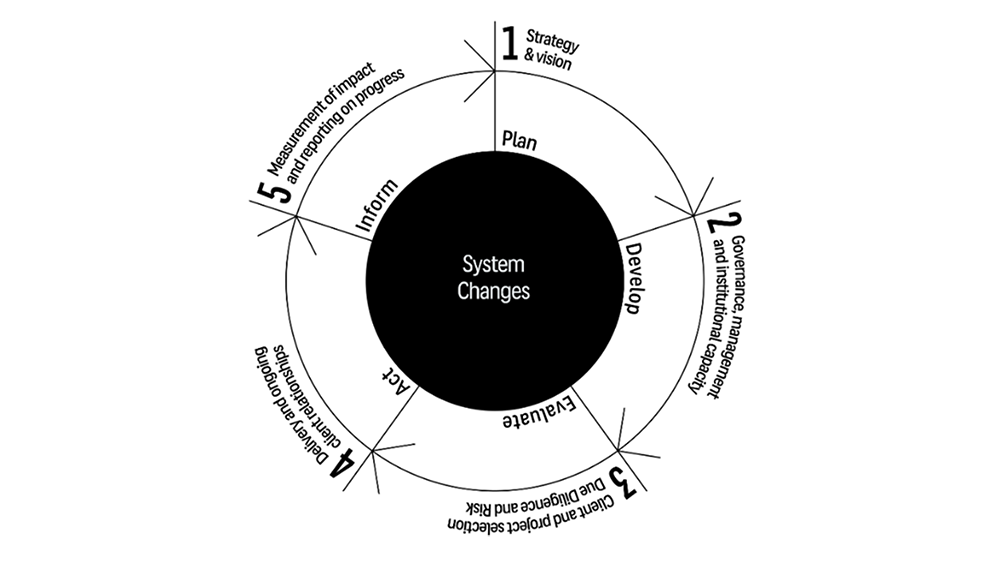
Fig 1. The continuous improvement model. Source: Beyond the Chaos: Ahead of the Curve report, Purpose Disruptors
In parallel, at Purpose Disruptors, we’ve been refining a nuanced application of this framework for advertising, and specifically working on refining the Advertised Emissions methodology, which helps agencies calculate the missing metric – the emissions associated with the uplift in sales their work generates. This allows organisations to identify carbon hotspots, embed accountability, and harness their influence for positive impact.
It makes influence tangible and, therefore, manageable.
Turning theory into practice
Frameworks get shared a lot, but not many get used. So we wanted to work collaboratively with industry practitioners. To make sure it's useful. And capture the learnings to share with the wider advertising ecosystem.
Our latest report, Beyond the Chaos, Ahead of the Curve, does just that. It maps out how this framework can be used with insight from our crack team of climate leaders.
What's more, two agencies, both very different, went deeper. Amplify and Elvis calculated their Advertised Emissions and mapped their journey in detail.
Amplify, a global creative agency working with brands like Google, Nike, and PlayStation, illustrates what's possible when climate moves from the sustainability silo into core business strategy.
Here, Jennie – Amplify's Head of Responsibility and Impact – outlines the lessons learned during this journey.
Making it actionable: Four insights from Amplify's journey
It helped us understand the true impact of our work
Our decision to embrace Serviced Emissions and the Advertised Emissions methodology wasn't driven by a box-ticking exercise, but by a desire to better understand the true impact of our work. For us, the goal has never been to force-fit purpose-led messaging, but to work collectively as creative problem solvers to find ways to minimise the negative impact our work has on the planet.
Transparency and humility sit at the heart of our approach
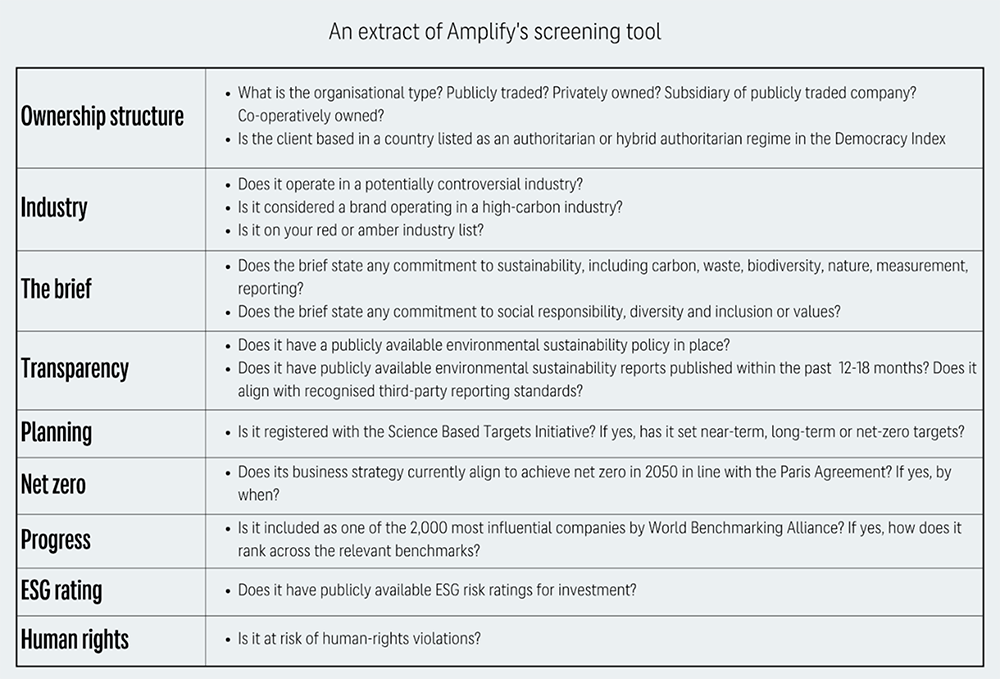
The first focus of the framework is understanding where you are now – which guided the development of our client screening tool. This enables more open, transparent conversations about new business opportunities. The tool forms part of our brief qualification process. It helps us interrogate briefs through a social and environmental lens using externally verified resources and globally recognised standards. It ensures accountability where decisions aren't black and white, while also highlighting real opportunities with clients who closely align with our values as an agency. See an except of the screening tool below.
Calculating our Advertised Emissions is an early risk indicator
As a brand experience agency, we carry a significant operational footprint due to the production of physical experiences. While much of our climate transition plan focuses on this area, we recognised the importance of understanding the true impact of the work we produce.
Calculating our Advertised Emissions for a subset of our clients has given us valuable insights into where our emissions and influence sit. It's not a perfect process. However, it has immediately helped highlight potential risk hotspots, areas for improvement and future opportunities.
As anyone involved in any form of carbon accounting will know, the most important thing is to start somewhere, and from there you're able to better interrogate the processes, data and methodology. That's where we're focusing next.
There is a strategic advantage to acting now
We embody a 'work in progress' mindset – constantly looking for every little inch, every day, to improve, adding to a bigger impact. The Serviced Emissions framework and Advertised Emissions methodology have started to give us a clearer map of both our influence and our next steps.
As an agency focused on continually evolving and redefining how and where audiences can experience brands, we know this evolution must play a bigger role in shaping the climate transition.
We're beginning to better understand the influence the creative and advertising industry really has on people's decisions, aspirations and behaviours. Storytelling is such an integral part of the industry, and it's becoming increasingly recognised that for decades it has been used to drive mass consumption and often mislead audiences. This work can hopefully act as a catalyst for the advertising industry and other service-based sectors to truly identify their full impact and in turn accelerate the change that is going to be required for industries to not just survive but thrive. You can also read more about the lessons Elvis has learned from measuring their emissions in our latest report, Beyond the Chaos.
The question isn't whether the industry will change, but whether you'll be ahead of the curve or scrambling to catch up.
Read the full report, Beyond the Chaos, Ahead of the Curve and join Purpose Disruptors’ webinar to derisk in uncertain times.