
Why Suncorp’s Haven exposes advertising’s climate blind spot
Published on Mumbrella.com.au, written by James Greet
‘The c-word is missing’: Purpose Disruptors co-founder James Greet argues that Suncorp’s award-winning Haven initiative misses the mark by focusing on resilience without confronting the climate crisis driving the need for it.
A couple of weeks ago, I, along with one of Purpose Disruptors’ founders Rob McFaul had the pleasure of being interviewed by Tim Burrowes for the Mumbrella podcast.
During our chat, Tim asked why Ad Net Zero here in Australia seems to have become almost invisible.
Sadly, I agreed; a massive shame given the huge work being put in behind the scenes by the various project and pillar leaders, including, of course, Arum Nixon, Ad Net Zero’s lead in Australia.
Not to forget the investment by its 30 or so members.
Personally, I think it’s down to two things.
First, the lack of noise and public support from the leaders of the member organisation’s themselves. Surely, a prerequisite of ANZ membership is your visible leadership?
Secondly, our output as an industry, i.e. our creativity, our ads, our content, are simply not reflecting the purpose of Net Zero’s action five: “Harness advertising’s power to influence culture and drive positive change”.
A frustration compounded by recent industry recognition of Suncorp’s “Haven”as a “sustainability” initiative. Because as much as we’d love to have seen an Australian campaign be a global role model for championing environmental sustainability and positive change, the simple truth is that it isn’t.
It’s nowhere near.
To be clear, resilience, the practice of protecting oneself from the consequences of environmentally unsustainable behaviour, is not being environmentally sustainable.
It’s been almost two weeks since Leo Australia won the Cannes Lions International Festival of Creativity Titanium Grand Prix for Haven.
I entered our address and it helpfully informed me that we aren’t at risk from flooding (thanks – we live at the top of a hill), but it might get very windy, so we should get some insulation tape from Bunnings. I also tried entering an address of ours in Mackay, North Queensland, a region at increasingly severe risk of extreme weather but it didn’t have the data available sadly.
According to Suncorp’s Haven site, they use the same data sources that Suncorp “applies to model the likelihood and severity of expected claims costs”; and no doubt your (climate-caused) increased premiums.
With Haven I’d argue that Leo has simply done for Suncorp what Ogilvy did with “personal carbon footprints” for BP back in 2004. Confuse people with language and make it their problem to fix. But that’s another point altogether.
My most fundamental issue with Haven is this: nowhere in the Haven experience itself is climate change mentioned. Only it seems in award entries and award PR.
Now, somewhat closer to home, I see that this week Haven has been shortlisted in two of the ACA AWARD creativity for good categories, including sustainability.
In case you missed it, the Haven initiative is, according to Suncorp, “an Australian first… the latest initiative from Suncorp, helping to build a more resilient Australia.”
“Each year, more and more Australians experience the devastating impact of extreme weather,” the pitch continues. “To help people prepare and protect their homes, Suncorp Haven is an innovative, dynamic data-led digital experience, designed to educate people about their home’s weather risks and resilience needs.”
Simply stick in your address, and hey presto, your home’s voice tells you what weather-related risks to watch out for and what to buy from Bunnings to fix it.
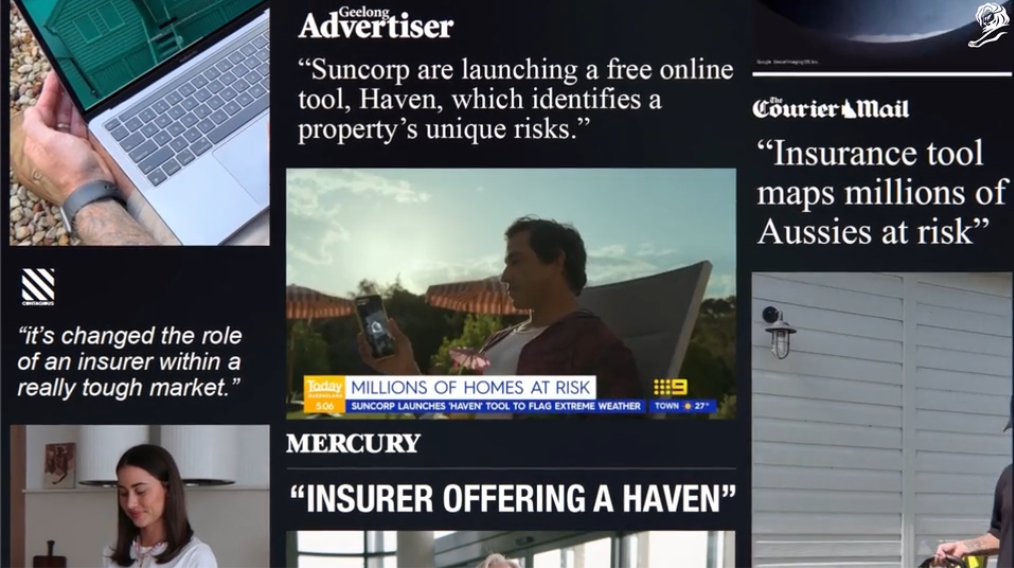
Since Suncorp’s Haven was launched, neither the Haven experience itself, the PR announcements last year, nor the recent celebration of the Cannes win have mentioned climate change. Let alone the increasing frequency and severity of the weather events it’s creating. Only a reference to extreme weather. Check Haven out for yourself and see: the ”c” word is missing in action.
Let’s be clear: Haven is a result of havoc. The havoc created by human-caused climate change. Mainly through the burning of fossil fuels. And 60% of GHG emissions are a consequence of household consumption.
Ironically, even as the winning Leo’s team stood on stage accepting the Titanium award, they were literally in the midst of the worst ever climate change-induced heat event that Europe, and especially France, has ever experienced. It recorded the highest ever temps in many of these countries, for longer, and indeed in France it’s ongoing.
As a direct result, it caused the deaths of over a 1000 people in France alone during Cannes week. Of whom 40 died from drowning while trying to escape the heat. Schools in southern England closed for 2 days. Hospitals were hosing down aircon systems. Medical equipment was failing. Surgeries were being cancelled. Systems were simply overwhelmed.
Yet even in the various celebration posts placed on Linkedin, there were still no mentions of climate change. Let alone the catastrophe the team were in the midst of.
So how could it be better?
One obvious answer is to very clearly highlight in the Haven experience that human-caused climate change is behind the increasing severity and frequency of events.
Adding a list of all the stuff households can do to adopt more sustainable household behaviours, reduce their emissions, and thereby lower their cost of living. Acknowledging in future when there’s a massive climate-change-caused weather event that’s overwhelming Europe going down whilst you’re celebrating the win. Simple stuff really.
We get it. Upton Sinclair famously said: “It is difficult to get a man to understand something, when his salary depends upon his not understanding it.”
Leo Burnett, Publicis Groupe, and maybe Suncorp Group have clients and investors for whom climate change is an inconvenient truth.
The reality is that these extreme climate changes are already baked in, so we need to build resilience and prepare as we clearly aren’t ready. But we also still need to get on with reducing our impact to avoid even worse scenarios, and importantly, continue to call out climate change and its effects as it is — essentially genuine, environmentally sustainable actions.
James Baldwin famously said: “Not everything that is faced can be changed. But nothing can be changed until it is faced.”
Our industry has a massive role to play in driving the behavioural changes we need to shift society to more sustainable behaviours. But first, we need to face up to the realities and truths about where we currently sit to be genuinely effective, beyond simply awards fluff.
For these reasons, we are hosting Purpose Disruptors pub meet-up next Wednesday, 15 July from 6pm-8pm at Sydney’s East Village Hotel, and you are all welcome.
