Why measuring our Advertised Emissions can help get ahead of inevitable climate pressures
17 Dec 2024 - Aimee Brewerton, Purpose Disruptors
Advertising’s Evolutionary Moment is a new framework that helps the ad industry turn climate ambition into impact. Early adopters of the framework like OLIVER and M&C Saatchi are better able to align their services with climate goals, explains the Purpose Disruptors’ Aimee Brewerton.
In the face of our current climate crisis, what does it mean to act logically? The Oxford English Dictionary defines logic as a choice that’s “expected or sensible under the circumstances”– an action both reasonable and rooted in sound judgment. This clarity struck me when Lucy Usher, Head of Sustainability at OLIVER, shared why the UK business began measuring its Advertised Emissions and adopted a framework to assess future risks and opportunities, given our climate trajectory. “It was simply the logical thing to do,” she said.
To make sound, logical choices, we need a clear, honest understanding of where we stand. Science shows we’re on track for 3°C of warming above pre-industrial levels. At that threshold, the planet’s capacity to support human life as we know it is severely compromised: food security becomes a challenge, water scarcity increases, and the economies we rely on are strained. When we consider the stakes, they’re high for every sector, including advertising.
Spotting the incoming risks
In this context, “business risk” takes on new dimensions. For those aiming to future-proof their company, it’s essential to ask: how can we contribute to a stable economy on a finite planet? What role should we play in this transformation?
Pressure is mounting across regulatory, reputational, and financial channels, with national and local governments implementing new laws against high-carbon advertising. Countries like France and several UK cities, including Edinburgh and Sheffield, have restricted high-carbon advertising. Climate-washing litigation is also rising; since 2016, over 120 cases have emerged, with a rapid increase in the last two years alone. Regulatory bodies like the UK’s ASA and CMA are expanding their enforcement, while financial disclosure frameworks such as the TCFD (Task Force on Climate-related Financial Disclosures) are making climate-related financial risks mandatory, with the UK mandating TCFD compliance by 2025.
Corporate clients are increasingly demanding sustainable practices from agencies, with some, like IKEA and H&M, requiring agencies to align with the Paris Agreement through their procurement processes. Even investors managing over $120 trillion in assets have voiced concerns, noting that agency services provided to high-carbon clients can contribute to substantial climate impact. The stakes are higher than ever for advertisers, who now face escalating risks across regulatory, reputational, and investor domains.

Fig 1. The surround-sound of pressure. Source: Advertising’s Evolutionary Moment report (2024), Purpose Disruptors
A clear pathway for leadership in service sectors
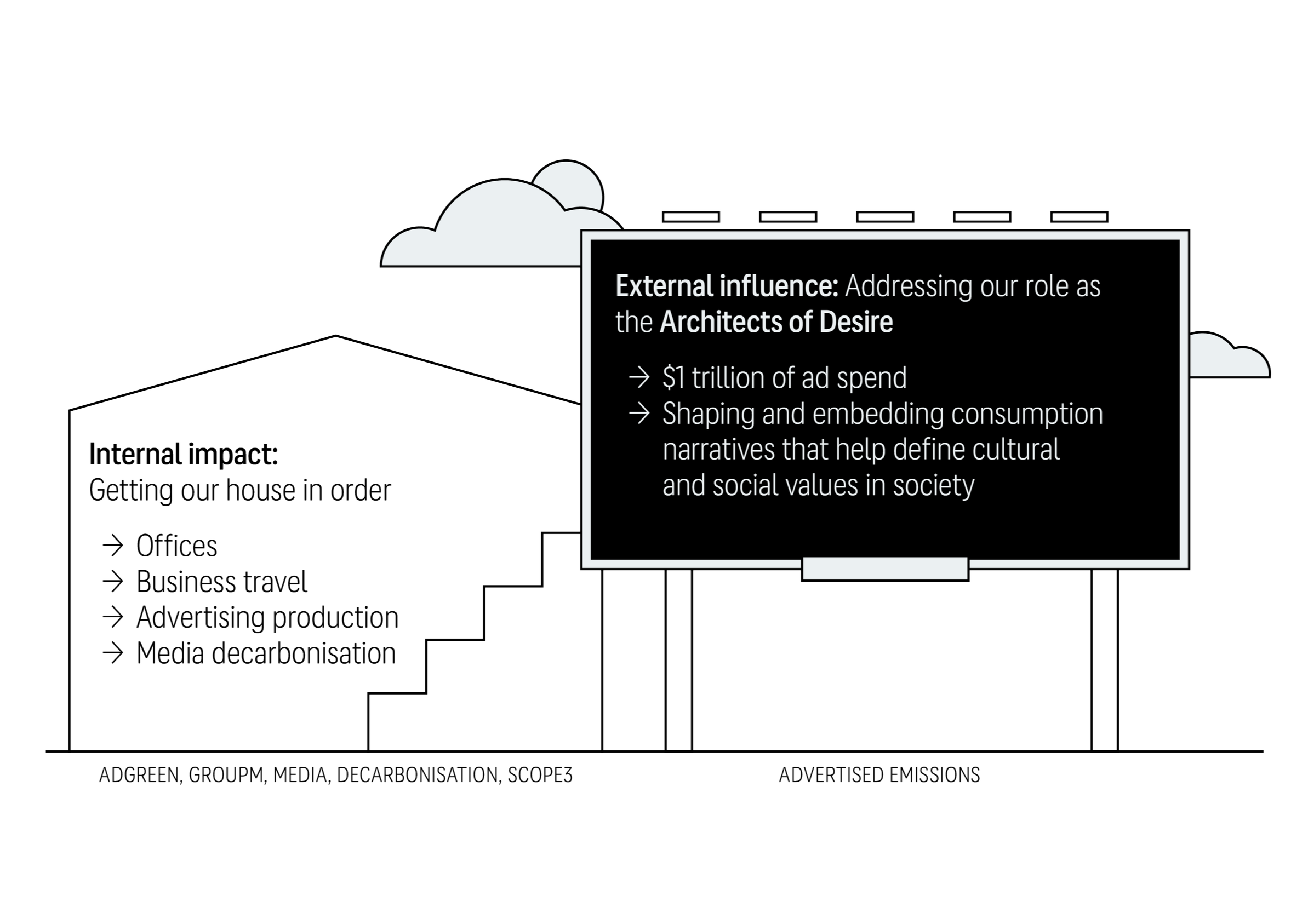
Service sectors like advertising, law, consulting, architecture, PR, and finance wield tremendous influence over societal behaviours and industry norms. They underpin the global economy, representing $7.5 trillion global GDP. Yet historically, these sectors focused primarily on operational emissions, often overlooking the emissions they indirectly drive through the services they provide. That’s where the concept of Serviced Emissions becomes essential.
Two recent developments brought us closer to a clear pathway for leadership. Climate heavyweights – Race to Zero, a UN-backed campaign to halve global emissions by 2030, and Oxford Net Zero, a leading research team on net-zero commitments, collaborated to develop the Serviced Emissions framework. This framework provides professional service sectors with the tools to identify climate-related opportunities and mitigate risks, creating a comprehensive, climate-aligned business strategy.
Serviced Emissions represent the GHG emissions that professional services (i.e. law, accounting, advertising) influence through their services. In advertising, these are known as Advertised Emissions – the GHG emissions associated with increased sales driven by marketing efforts. For legal services, these are Advised Emissions, or the emissions impacted by legal advisories or decisions.
The new framework includes a six-point action plan guiding organisations through climate-aligned practices in strategy, governance, client relationships, and impact measurement. It empowers Professional Service Providers to incorporate climate accountability into their business models, transforming how they engage with clients and navigate future risks.
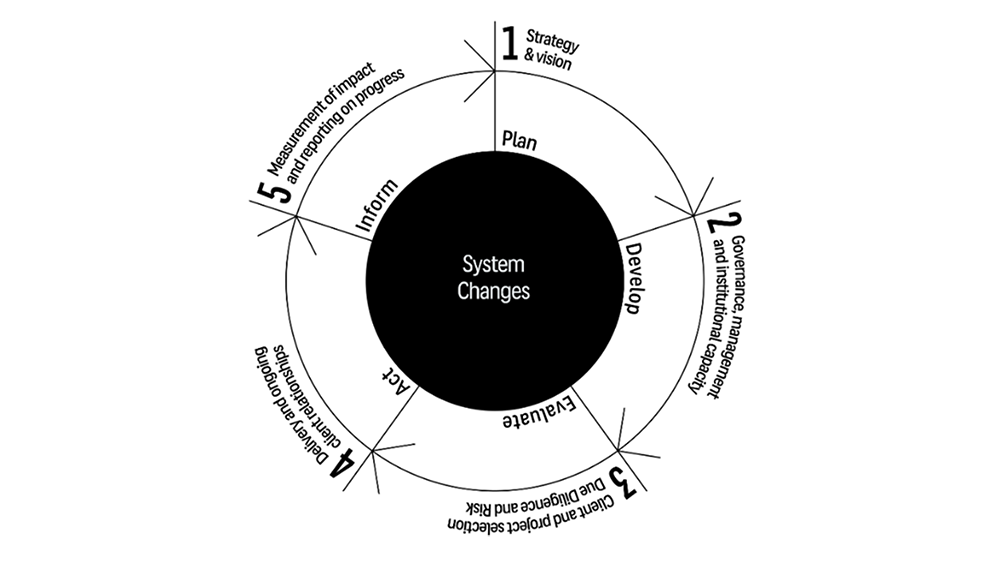
To showcase how this framework translates to action, Purpose Disruptors, in collaboration with OLIVER and M&C Saatchi, recently published Advertising’s Evolutionary Moment: How to Turn Climate Ambition into Impact. The case study documents early adopters of the framework and their steps toward aligning services with climate goals.
OLIVER, for instance, began by measuring the Advertised Emissions for their top 20 clients and found that these emissions were approximately 42 times higher than the agency’s operational emissions in the same year. In response, they’re now reviewing approaches to longer-term client portfolio planning with this in mind, including a commitment not to pitch for fossil fuel clients since January 2024.
M&C Saatchi, on the other hand, has aligned its incentive structure with climate and social outcomes, tying financial performance to measurable sustainability goals.
Adopting this approach brings multiple benefits for agencies like OLIVER and M&C Saatchi including:
In a stronger position to mitigate climate risk
They are positioned as leaders and driving competitive advantages
By prioritising climate-conscious clients, they’re attracting talent who care about sustainability, increasing brand differentiation
Laid the groundwork to meet evolving procurement requirements
All of this bolsters resilience, preparing them for an inevitable shift where businesses that ignore climate risks may find themselves unviable – whether through legal limitations or environmental collapse.
In many ways, climate-aligned business practices are becoming inevitable. The choice is no longer about whether to act but how quickly we can adapt. As Lucy Usher put it, “It was simply the logical thing to do,” and she couldn’t be more right.
Source: Advertising’s Evolutionary Moment (2024), Purpose Disruptors